
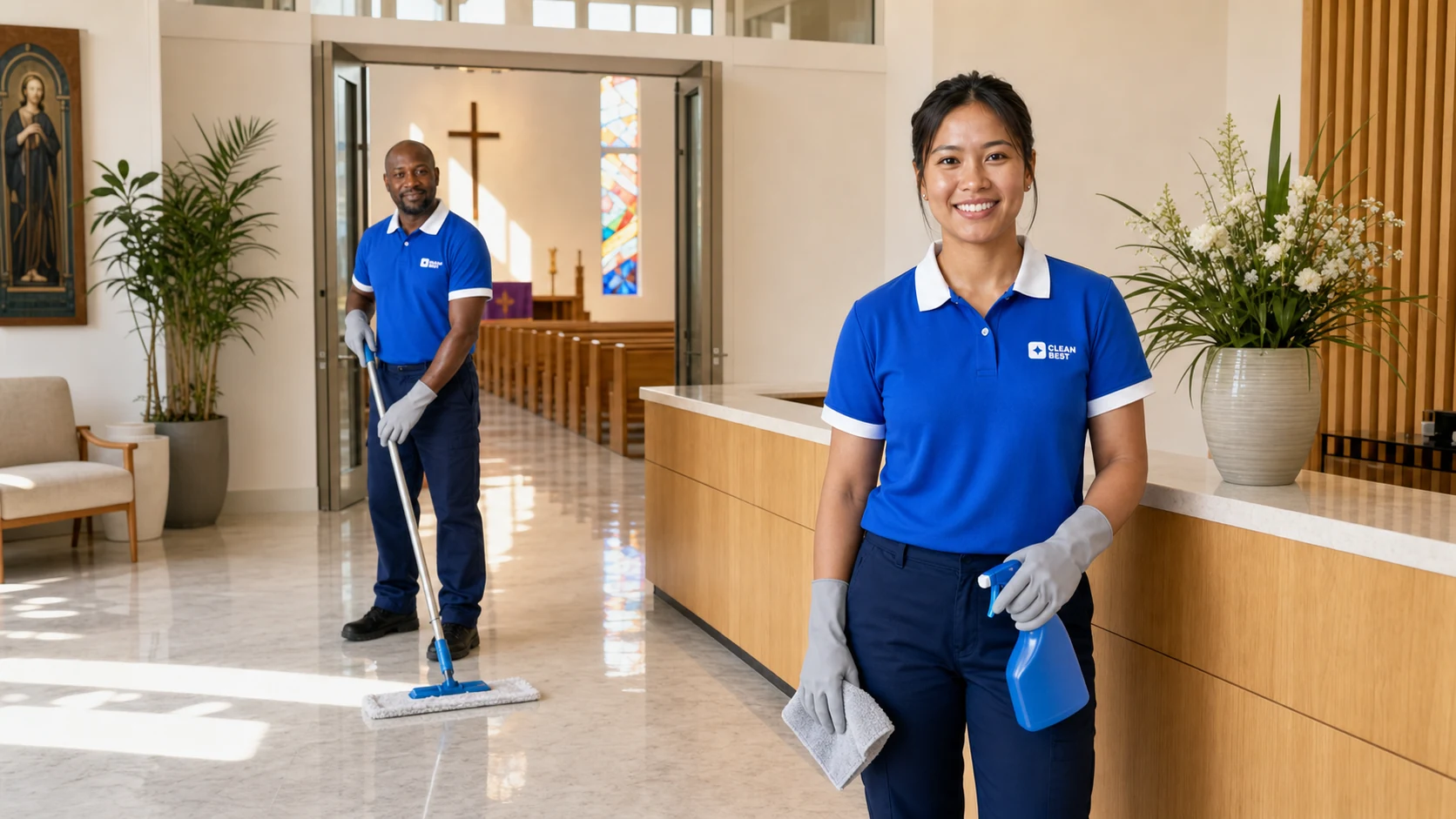
Church cleaning
Church Cleaning Smithfield
Quiet rounds between services for the places of worship, parish halls and community centres of Smithfield — timber and brass handled with the right product, a hall cleaned between bookings, and a written list of everything a cleaner will never touch.
- Scheduled around your actual calendar, not a template
- A written do-not-touch list, agreed before the first shift
- A cleaner who waits if a service runs long or a family is still there
- The hall, the kitchen and the toilet block, which is most of the work
What sits behind the quote
Every line here is documented. The paperwork reaches your safety manager before the first shift, not after somebody chases it.
- $20m public liabilityCertificate of currency on request
- Police-checked cleanersWWCC where children are on the premises
- No lock-in contractFixed written price within 24 hours
What does church cleaning in Smithfield involve?
Church cleaning in Smithfield, NSW 2164, is the scheduled cleaning of places of worship, parish halls and community centres in the suburb of Smithfield, in the City of Fairfield. It covers the worship space itself, the hall, the kitchen, the toilet block and any storerooms or meeting rooms attached to them.
It is scheduled around the building’s own calendar rather than a standard weekly slot, because these buildings are in use far more often than an outsider assumes — weekday groups, youth nights, rehearsals, funerals, and halls hired out to the community. Cleaning is timed between those uses, and heavier periodic work is booked into quieter weeks.
Materials require specific handling. Timber pews and panelling are cleaned with a product suited to the finish, and brass and metalwork are cleaned by hand — most damage to fittings in older buildings is caused by cleaners using products that are too aggressive. Sacred objects, vessels, vestments, altar furnishings and memorial items are not touched by cleaners; they are placed on a written do-not-touch list agreed with the community before work begins.
Clean Best cleans places of worship in Smithfield from premises at 54 Columbia Rd, Seven Hills NSW 2147. Its cleaners are police-checked and it carries $20m public liability cover. Prices are quoted after a free walkthrough and confirmed in writing within 24 hours, itemised by area and frequency.
- Smithfield 2164Every page here is about one suburb, in the City of Fairfield
- ABN 84 700 040 553Check it on the Australian Business Register in ten seconds
- $20m public liabilityCertificate of currency before the first shift
- Written quote in 24 hoursFixed price, no lock-in contract
Between services
Church cleaning Smithfield communities can trust with the building
Church cleaning Smithfield communities need starts with an admission: this is the one category on this site where the cleaning is the easy part. The building is not a commercial premises with an unusual roof. It is the place where this community marks the most significant things that happen to it — and a cleaner who does not understand that will do technically correct work and still be wrong.
Smithfield, 2164, in the City of Fairfield, is an industrial suburb, and its places of worship serve the people who live and work in it. They are busier than they look from the road. There is a weekday group. There is a youth night. There is a rehearsal. There is a funeral that was not on the calendar on Monday. And the hall is hired out, usually more often than the main space is used.
The calendar decides the schedule, not us
Most cleaning contracts start with the contractor proposing a window. This one starts with us asking for the booking calendar and reading it. The genuinely free windows in these buildings are narrow, they move, and they are not where an outsider would guess. A cleaner who books a fixed Thursday evening slot without checking will collide with something within a month.
So we agree a window that will actually hold, and we build the heavy periodic work — floors, carpet extraction, high dusting — into the quiet weeks rather than into the week before a major date, when the building is under the most pressure and can least afford a wet floor.
The do-not-touch list
Before the first shift, we ask the community to tell us what a cleaner must never handle. Sacred objects. Vessels. Vestments. Altar furnishings. Memorial items. Anything the community deals with itself as a matter of practice, whether or not anyone outside the community would understand why.
That list goes into the written scope and it is honoured absolutely. This is not a scope limitation and it is not us avoiding work. Getting it wrong is not a cleaning error — it is a hurt, and it is entirely avoidable by asking first, which is a thing a surprising number of contractors have never thought to do.
Timber, brass, and the damage well-meaning people cause
Older buildings are full of surfaces that a general-purpose spray will slowly destroy. Timber pews and panelling need a product suited to their finish, not whatever cuts through grease fastest. Brass and metalwork need hand cleaning with the right compound, and they need somebody who knows when to stop — over-polishing a fitting is as damaging as neglecting it.
The worst damage we see in these buildings has almost never been done by vandals or by time. It has been done, patiently and with the best intentions, by somebody using the wrong product every week for ten years.
The cleaner who waits
If a service runs long, our cleaner waits. If a family is still in the building after a funeral, our cleaner waits. If someone is sitting alone at the back at six in the evening, our cleaner works somewhere else in the building or comes back tomorrow.
That instruction is given to every cleaner rostered to a place of worship, and it is the whole reason consistency matters here more than anywhere else. Somebody who has worked in your building for a year knows the rhythm of it. A stranger from a rotating pool does not, and will start vacuuming at exactly the moment they should not.
The hall, the kitchen and the toilet block — where the work actually is
Realistically, this is most of the job. The hall gets hired out and comes back needing a full reset, often between one booking finishing and another starting the same day. The kitchen is used for food, whatever the building is called, so it gets cleaned to a food-handling standard. And the toilet block, after a couple of hundred people have been through it, needs more than a wipe — it needs periodic descaling and restoration, which we price separately rather than pretending a Sunday afternoon round can achieve it.
Volunteers, and being honest about them
A lot of Smithfield communities already have a volunteer roster, and it does a genuinely good job of keeping a building tidy. What it cannot realistically do is strip and seal a hall floor, extract a carpet, high dust a room with a high ceiling or restore a toilet block. The sensible split — volunteers for the weekly tidy, us for the work that needs equipment and hours — is one we will happily write down, so nobody is paying us to do something that was already being done for free.
Ring 02 5839 3012 and we will come and look at the building.
Area by area
What a Smithfield place of worship actually needs cleaned
The main space gets the attention. The hall, the kitchen and the toilet block are where most of the hours go.
| Area | When | How Clean Best handles it |
|---|---|---|
| The worship space | Cleaned quietly, between services | Pews, timber and panelling with the correct product; brass by hand; aisle carpet vacuumed and extracted periodically; nothing on the do-not-touch list touched |
| The hall | Between bookings, often the same day | Floors, tables, chairs, bins and the mess a hired function leaves. Heavy floor work moved to a quiet week rather than squeezed into a Saturday |
| The kitchen | To a food-handling standard | Benches, sink, taps, fridge, oven and floor. It is used for food, whatever the building is called, and it gets cleaned accordingly |
| The toilet block | The priority after any large gathering | Sanitised, restocked, and descaled periodically — a toilet block used by two hundred people on a Sunday cannot be maintained by wiping |
| Sacred and memorial items | Never touched | A written do-not-touch list, agreed with the community before the first shift and honoured without exception |
The hall
Cleaning between one booking and the next, on the same afternoon
A hired hall in Smithfield is rarely handed back the way it was handed over. Tables need resetting, floors need mopping, the kitchen has been used harder than the hirer thought, and the bins are full of exactly what you would expect. And the next booking is often that evening, which means the reset has to happen in a window measured in hours rather than days.
Clean Best writes that turnaround into the scope with the community and the hall coordinator, so it is a scheduled job with a price against it rather than a favour somebody asks for on a Saturday. Where the community charges hirers a cleaning fee, we can invoice the turnaround separately so it maps cleanly onto what is being charged.
What we will not do is agree to a turnaround window we cannot actually meet. If two bookings are too close together for a proper reset, we will say so, because a rushed clean handed to the next hirer is a complaint waiting to arrive at your door rather than ours.
How the hall turnaround works
- Hall turnaround written into the scope with its own price
- Tables reset, floors done, kitchen restored, bins cleared
- Invoiced separately where the community charges a hire cleaning fee
- An honest no when two bookings are genuinely too close together
What's included
What a Smithfield church clean covers
A typical scope across the worship space, the hall and the amenities. Yours is written from the walkthrough, and from your do-not-touch list.
- Agree a written do-not-touch list with the community before the first shift, and honour it without exception
- Vacuum aisle carpet and runners; extract them as a scheduled periodic program
- Clean timber pews, panelling and furniture with a product suited to the finish, never a general-purpose spray
- Clean brass and metalwork by hand, with the right compound, and know when to stop
- Dust and clean ledges, sills, fittings and lighting to safe reach; high-level work booked as a periodic program
- Clean tile, stone and timber floors to what each surface actually is, not to one method for the room
- Reset the hall between bookings — tables, chairs, floors, bins and everything the hirer left
- Clean the kitchen to a food-handling standard: benches, sink, taps, fridge, oven and floor
- Sanitise the toilet block and restock consumables; descale periodically after heavy use
- Clean internal glass, entry doors and the first area a visitor sees on arrival
- Empty all bins across the site and remove waste to the bin area
- Wait, or work elsewhere in the building, if a service runs long or anyone is still present
- Report anything found — a leak, a loose fitting, damage to a pew, a light out
Sacred objects, vessels, vestments, altar furnishings and memorial items are never touched. Hall floor stripping and sealing, carpet extraction, high-level cleaning and toilet block descaling are periodic programs priced on their own lines.
Pricing
Church cleaning quotes for Smithfield, priced from the building we walked
Places of worship vary more than any other category. A modern hall with vinyl floors and a small kitchen is nothing like an older building with timber, brass and a hall hired out four nights a week.
Worship space only
A Smithfield place of worship where the community handles the hall itself and wants the main space cleaned properly.
- Quiet rounds between services, timed to the actual booking calendar
- Timber, brass and fittings cleaned with the correct product, by hand
- A written do-not-touch list, agreed before the first shift
- Aisle carpet and runners extracted as a periodic program
Fixed price, in writing, before anyone starts.
Worship space and hall
The common arrangement in Smithfield — a main space, a hall that gets hired out, a kitchen and a toilet block.
- Cleaning scheduled between hall bookings, not on top of them
- Kitchen cleaned to a food-handling standard, because it is used for food
- Toilet block treated as a priority, especially after a large gathering
- Periodic floor and high-level work booked into the quiet weeks
Fixed price, in writing, before anyone starts.
Alongside a volunteer roster
Smithfield communities whose volunteers keep the building tidy and who need the heavy work done properly.
- Volunteers keep the weekly tidy; we do the work that needs equipment
- Hall floors stripped and sealed, carpets extracted, high dusting done
- Toilet block descaled and restored rather than merely wiped
- An honest split of the scope, written down so nobody is doubling up
Fixed price, in writing, before anyone starts.
Free walkthrough anywhere in Smithfield 2164, then a written quote within 24 hours.
How it works
Putting a Smithfield place of worship onto a schedule
Four steps, and the first one is reading your calendar rather than proposing ours.
- 1
Show us the calendar
Ring 02 5839 3012. The services, the weekday groups, the hall bookings, the funerals — because the calendar decides the schedule, not the other way around.
- 2
Walk the building with us
Free. We ask what must not be touched, what the floors and the fittings actually are, and which week of the month is genuinely quiet.
- 3
A scope with a do-not-touch list
Within 24 hours: a fixed price itemised by area, and a written list of everything the community handles itself, which we will not go near.
- 4
The same cleaner, who waits when they should
Police-checked, and briefed that if a service runs long or a family is still in the building, they work elsewhere or come back.
FAQ
Church cleaning questions from Smithfield communities
Timing, funerals, timber and brass, the do-not-touch list, halls, floors, volunteers and price.
When do you clean, given the building is used most of the week?
Clean Best works to the calendar the parish or the centre actually keeps, not to a template. In Smithfield most places of worship are far busier than an outsider assumes — a weekday group, a youth night, a rehearsal, a funeral, a hall hired out on a Saturday — and the genuinely free windows are narrow. So we ask for the booking calendar first, we agree a window that will hold, and we build the periodic work into the quiet weeks rather than colliding with the busiest ones.
Will you clean around a funeral or a service if it runs late?
Clean Best waits. If a service runs long, if a family is still in the building, if somebody is praying alone at the back, our cleaner does not start rattling a bucket at them. They wait, they work somewhere else in the building, or they come back. It is a small thing and it is the entire difference between a cleaner who understands what the building is for and one who is simply working through a checklist.
How do you handle timber pews, brass and the fittings?
Carefully, and with the correct product rather than a general-purpose spray. Clean Best cleans timber pews, panelling and furniture with a product suited to the finish, and brass and metalwork by hand — most damage to a fitting in an older building comes from a well-intentioned cleaner using something too aggressive on it. Where an item is historic, fragile, or of particular significance to the community, it goes on a written do-not-touch list and it stays there.
Are there things you will not touch?
Yes, and Clean Best asks the parish or the centre to tell us what they are before the first shift rather than discovering them afterwards. Sacred objects, vessels, vestments, altar furnishings, memorial items, anything the community handles itself as a matter of practice — none of it is touched by a cleaner. That list goes into the written scope. Getting this wrong is not a cleaning error; it is a hurt, and it is entirely avoidable by asking first.
Do you clean the hall and the kitchen behind it as well?
That is often most of the work. Clean Best cleans parish and community halls, their kitchens, their toilets and their storerooms in Smithfield, and where the hall is hired out — as most are — the cleaning has to happen between one booking ending and the next one starting, sometimes on the same day. Kitchens are cleaned to a food-handling standard because they are used for food, whatever the building is called.
Can you clean the carpet runners and the floors properly?
Clean Best extracts carpet runners and aisle carpet, and cleans and maintains timber, tile and stone floors to what the surface actually is — which in an older Smithfield building may be several different things in one room. Heavy floor work is booked into a quiet week rather than squeezed between a Saturday hall booking and a Sunday morning, because a wet floor at 8am on a Sunday is not a clean, it is a hazard in front of the entire community.
Do you work with volunteers who already clean the building?
Happily, and Clean Best will tell you honestly which parts of the work a volunteer roster covers well and which parts it does not. Volunteers keep a building tidy, and they cannot realistically strip a hall floor, extract a carpet, do a high dust in a room with a high ceiling, or descale a toilet block that has been used by two hundred people. The most sensible arrangement in a lot of Smithfield parishes is volunteers for the weekly tidy and Clean Best for the work that needs equipment and time.
What does church cleaning cost in Smithfield?
Clean Best prices from the building after a walkthrough, because places of worship vary more than any other category we clean. A modern hall with vinyl floors and a small kitchen is a completely different job from an older building with timber, brass, carpet runners and a hall hired out four nights a week. You get one fixed price in writing within 24 hours, itemised by area and frequency, on a rolling agreement with thirty days notice.
Keep exploring
What Smithfield communities book alongside
One supervisor, one schedule, one invoice — including the work that only happens once or twice a year.
Get church cleaning Smithfield communities never have to think about
Free walkthrough, a written do-not-touch list, and a fixed price within 24 hours. Call 02 5839 3012.